Engineering Reliability into Every Coating Pot
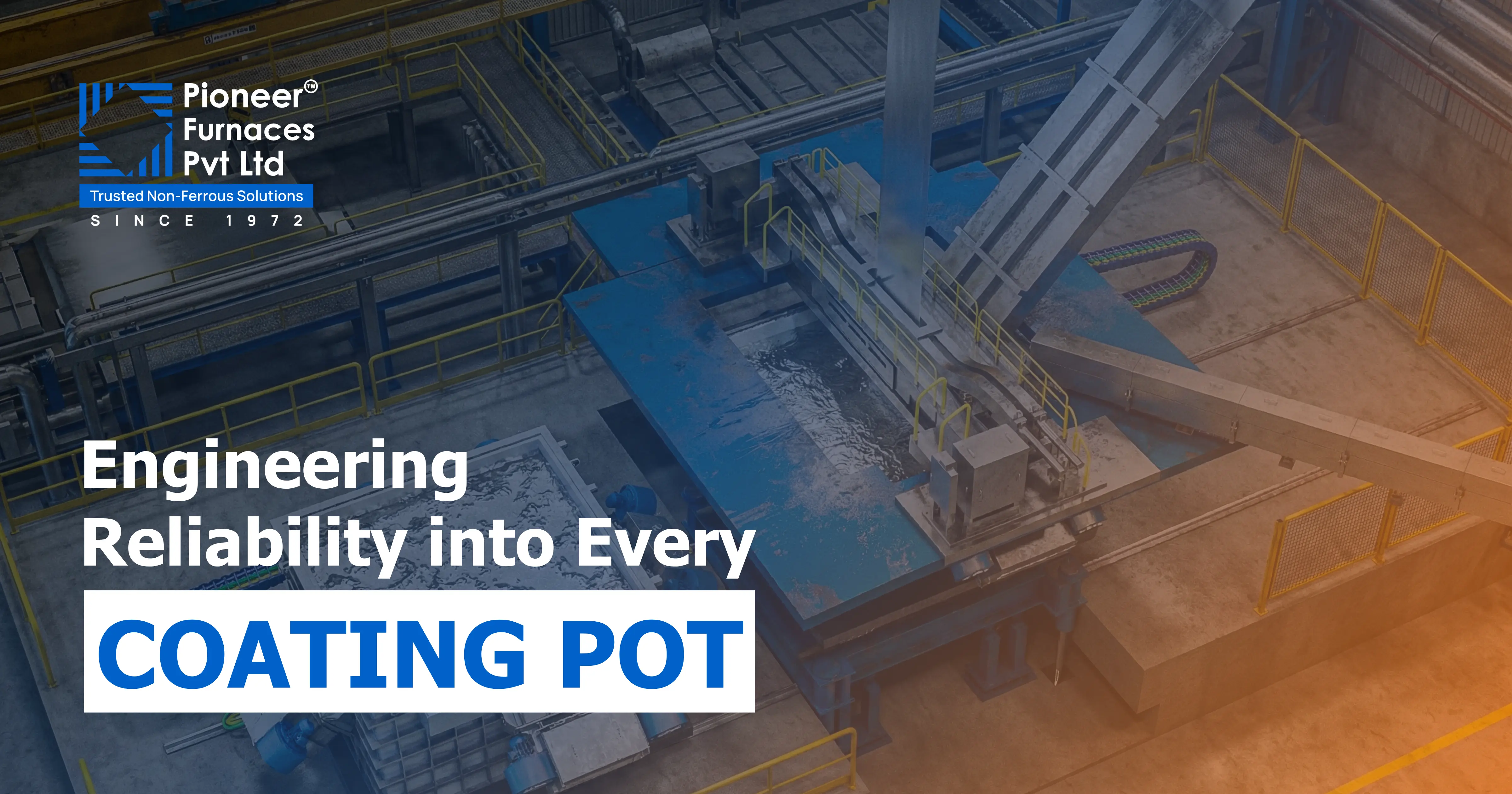
How Pioneer Builds High-Performance Coating Pots for Continuous Galvanizing Lines
In a Continuous Galvanizing Line (CGL), many systems work in coordination — annealing furnaces, strip handling, air knives, automation. Yet, at the heart of the entire process lies one component that ultimately determines coating quality, metal consumption and line stability – the Coating Pot.
Far from being a simple vessel holding molten zinc, a modern coating pot is a highly engineered metallurgical system. Its design governs temperature uniformity, alloy stability, dross formation, uptime and eventually the consistency of the coated product.
At Pioneer Furnaces, coating pots are engineered with the same philosophy that has guided the company for over five decades – reliability through sound engineering, not shortcuts.
The Role of the Coating Pot in a CGL
In a continuous galvanizing process, the steel strip enters a molten zinc or zinc-alloy bath where a metallurgical bond is formed. For this process to remain stable over months and years of operation, the coating pot must:
- Maintain highly uniform bath temperature
- Ensure homogeneous alloy composition
- Operate continuously with minimal interruptions
- Minimize dross formation and zinc losses
- Integrate seamlessly with upstream and downstream systems
Any instability inside the pot is immediately reflected on the strip, i.e. in coating thickness variation, surface defects or excessive zinc consumption.
This is why leading CGL OEMs and steel producers increasingly evaluate coating pots as critical process equipment, not an accessory.
Engineering the Pot as a Metallurgical System
Pioneer approaches coating pot design as a complete metallurgical and thermal system, not merely a fabricated tank.
1. Structural Design for Long Campaign Life
Pioneer coating pots are built with heavy-duty steel shells designed to withstand continuous high-temperature operation and thermal cycling. The structural design prioritizes dimensional stability and long service life, even under demanding operating conditions.
2. Advanced Ceramic and Refractory Lining
The lining system plays a decisive role in pot life, thermal efficiency and zinc quality. Pioneer uses carefully selected ceramic and refractory materials that offer:
- High resistance to molten zinc and zinc-based alloys
- Low wettability, reducing zinc attack and erosion
- Improved heat retention and thermal stability
The result is longer refractory life, reduced heat losses and more stable bath conditions.
Induction Heating: Precision Where It Matters the Most
Temperature control inside a coating pot is not just about maintaining an average value, it is about uniformity across the entire bath.
Pioneer coating pots employ mains-frequency channel induction heating, a technology the company has specialized in for decades.
Key advantages include:
- Uniform heating and natural circulation of molten metal
- Elimination of localized hot or cold zones
- Faster response to load variations and drag-out losses
- Lower oxidation and reduced dross formation
- High electrical efficiency for long holding cycles
By integrating multiple inductors wherever and as required, Pioneer ensures consistent temperature distribution even in large-capacity pots handling 25 T to over 350 T of molten zinc.
Flow, Circulation and Dross Control
A coating pot is best understood as a controlled metallurgical reactor. Proper circulation of molten zinc in the pot is essential to:
- Maintain homogeneous alloy composition (Zn, Zn-Al, Zn-Mg, ZAM)
- Prevent stagnation zones that accelerate dross formation
- Ensure uniform heat transfer to the strip
Pioneer’s inductor and channel geometry is engineered to promote balanced, directional flow, improving zinc utilization and extending both pot and inductor life.
Engineering Innovation - DFO Technology:
Dynamic Flow Optimisation (DFO) is a proprietary innovation of Pioneer, engineered to outperform conventional flow principles.
DFO delivers:
- Balanced metal circulation (Jet + Directional Flow Synergy)
- Highly uniform temperature field across pot width, depth and length
- Reduced thermal gradients for longer refractory life
- Reduced cold spots and stratification
- Optimized power-to-melt transfer resulting in lowest specific energy consumption, higher coating consistency and reduced dross formation
Integration with Pre-Melt Furnaces and Launders
Modern galvanizing lines increasingly rely on pre-melt furnaces to prepare alloyed zinc before it enters the main pot. Pioneer designs coating pots as part of a fully integrated CGL melting ecosystem, including:
- Pre-melt furnaces for stable alloy preparation
- Heated launders for temperature-controlled metal transfer
- Automation systems for synchronized operation
This integration minimizes thermal shocks, stabilizes bath chemistry and improves overall line efficiency.
Automation, Monitoring and Process Stability
Reliable coating performance depends on repeatability. Pioneer coating pot systems can be supplied with advanced automation features, including:
- PLC-based temperature control with high accuracy
- Multi-point thermocouple feedback
- Integration with plant DCS / SCADA systems
- Data logging for trend analysis and process optimization
These systems help operators maintain tight control over critical parameters while enabling predictive maintenance and faster troubleshooting.
Built on Experience, Proven in the Field
With over 259 coating pot inductors installed and a strong presence across India’s galvanizing industry, Pioneer Furnaces has earned a reputation for robust, dependable coating pot systems.
Pioneer coating pots operate in collaboration with leading CGL integrators and steel producers, supporting high-speed lines producing GI, GL, GA and advanced alloy-coated products.
The company’s strength lies not in offering a generic design, but in engineering each coating pot to suit the specific line configuration, alloy chemistry and operating philosophy of the customer.
Looking Ahead: Reliable, Efficient, Future-Ready
As galvanizing lines evolve toward higher speeds, tighter tolerances and stronger sustainability goals, the demands on coating pots will only increase. Energy efficiency, alloy flexibility, digital monitoring and long campaign life are no longer optional but they are indispensable parameters.
At Pioneer Furnaces, coating pot technology continues to evolve, guided by decades of induction expertise and a clear focus on long-term performance rather than short-term gains.
Conclusion
The coating pot may not always be visible on the finished steel product, but its influence is evident. From molten zinc to flawless coating, every step depends on the stability, design and reliability of this critical system.
By treating the coating pot as an engineered metallurgical solution, not just a container, Pioneer Furnaces delivers coating systems that help galvanizing lines run consistently, efficiently and profitably.
FAQs – Coating Pots for Continuous Galvanizing Lines (CGLs)
1. Is a coating pot simply a vessel for holding molten zinc?
No. A coating pot is a critical metallurgical system. Its design directly affects temperature uniformity, alloy stability, dross formation, zinc consumption, coating quality and line uptime.
2. Why is temperature uniformity inside the coating pot so important?
Uniform temperature ensures consistent coating thickness, stable alloy chemistry, reduced dross formation and lower zinc losses. Local hot or cold zones can quickly translate into surface defects on the strip.
3. Why are channel inductors widely used in coating pots?
Mains-frequency channel inductors provide uniform heating, natural metal circulation, fast thermal response and high efficiency for continuous operation—making them ideal for CGL applications.
4. How does coating pot design influence dross formation?
Poor circulation, temperature gradients and localized overheating increase dross formation. A well-engineered pot promotes balanced metal flow and stable thermal conditions, significantly reducing zinc losses.
5. What role does refractory and ceramic lining play?
The lining protects the pot shell, improves thermal efficiency and determines pot campaign life. High-quality refractory materials resist deposition and erosion from molten zinc and zinc alloys.
6. Can the same coating pot be used for different alloys such as GI, GL, or ZAM?
Yes, provided the pot and the electrical system are designed for alloy flexibility. Different alloys have distinct thermal and metallurgical behaviors, which must be considered during design.
7. Why are pre-melt furnaces often integrated with coating pots?
Pre-melt furnaces stabilize alloy chemistry and temperature before metal enters the main pot. This reduces thermal shock, improves bath stability and enhances overall line efficiency.
8. How does coating pot design affect zinc consumption?
Better temperature control and circulation reduces oxidation and dross formation. Over time, this can lead to significant zinc savings, especially on high-speed galvanizing lines.
9. What automation features are commonly used with modern coating pots?
Typical features include PLC-based temperature control, multi-point thermocouples, SCADA/DCS integration and data logging—ensuring repeatable performance and easier troubleshooting.